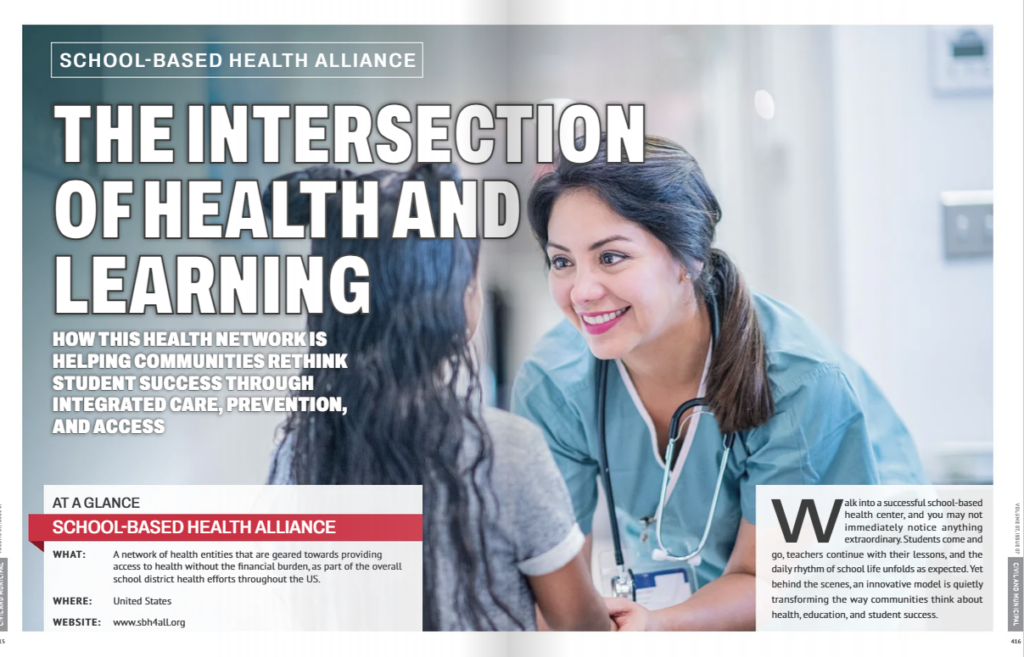
Walk into a successful school-based health center, and you may not immediately notice anything extraordinary. Students come and go, teachers continue with their lessons, and the daily rhythm of school life unfolds as expected. Yet behind the scenes, an innovative model is quietly transforming the way communities think about health, education, and student success.
At the center of this movement is the School-Based Health Alliance, an organization dedicated to supporting and expanding school-based health centers across the United States. Rather than functioning as part of the school system itself, these centers represent a strategic partnership between healthcare providers and educational institutions, creating a powerful intersection where learning and wellness meet.
For President Robert Boyd, understanding this distinction is critical.
“School-based health centers are not technically part of the education system,” Boyd explains. “They are independent operations that partner with local schools and school districts.”
That partnership model has become increasingly important as educators, healthcare providers, and policymakers recognize that academic achievement and health outcomes are deeply connected. A student struggling with untreated asthma, anxiety, depression, vision problems, or family instability cannot be expected to perform at their full potential in the classroom.
Boyd frames the concept simply.
“I always start with one question: how many people believe that healthy kids learn better?” Boyd says. “The research shows that communities, families, and students benefit when you have a school-based health center there because they’re able to not only treat problems, but they’re able to do prevention.”
The emphasis on prevention represents a fundamental shift from traditional healthcare models that often focus primarily on treating illness after it appears. School-based health centers seek to identify issues earlier, intervene more effectively, and create healthier outcomes over the long term.
An Idea That Evolved Through Experience
The concept of bringing healthcare into schools is not new. In fact, the model has undergone decades of evolution as communities worked to determine the most effective structure.
Chief Strategy Officer Laura Brey has witnessed much of that journey firsthand.
“I’ve been in this field since 1983,” Brey says. “I helped start the first school-based health center in Chicago at the time.”
According to Brey, early efforts often struggled because schools attempted to manage healthcare operations themselves. While the intentions were good, educational institutions were not equipped to function as healthcare providers.
“Schools are not healthcare providers,” Brey explains. “When they tried to take on the funding and run them, they didn’t know anything about it. They didn’t know what they were doing.”
Over time, communities learned that sustainable success required partnerships with organizations whose expertise was in healthcare. Hospitals, local health departments, physician practices, and eventually federally qualified health centers became natural partners.
Today, approximately two-thirds of school-based health centers are operated by federally qualified health centers. The model provides both clinical expertise and a financial structure capable of supporting long-term operations.
The result is a collaborative framework that clearly defines responsibilities while ensuring healthcare services become an integrated part of school culture.
“Those who are successful are seen as part of that school,” Brey says. “The staff who work there are known by all the teachers. They’re known by the principal, the dean of students. They’re known by the kids and their parents.”
That familiarity helps create trust, one of the most important ingredients in delivering effective healthcare.
Treating the Whole Child
One of the defining characteristics of school-based health centers is their commitment to comprehensive care.
Unlike traditional school health services that may focus primarily on immediate medical concerns, school-based health centers address multiple dimensions of student wellness.
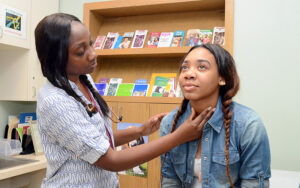
Typically, students have access to medical providers such as nurse practitioners or physician assistants. Many centers also offer behavioral health services, oral healthcare, vision care, and referrals to specialized providers when needed.
For Boyd, this integrated approach is essential.
“What we’re trying to show the students and the families is it’s all just health,” Boyd says. “Your behavioral health is no different than your physical health. You have to take care of it.”
This philosophy helps reduce stigma surrounding mental health concerns while encouraging students to seek support before problems become crises.
The centers also work alongside school nurses, counselors, psychologists, and social workers rather than competing with them.
“We are not in competition with each other,” Boyd emphasizes. “We’re all different. We all work together.”
That collaborative approach creates a broader support network for students while allowing each professional to focus on their area of expertise.
The impact can be significant. Students receive care without missing an entire day of school, parents avoid losing work time for routine appointments, and healthcare providers gain opportunities to identify issues before they escalate.
According to Brey, access alone changes outcomes dramatically.
“In a school-based health center, most of the kids use it,” Brey says. “They use the center not only for their well-care visit but for other problems too.”
Addressing Challenges Beyond Medicine
Perhaps the most distinctive aspect of the school-based health model is its recognition that health is influenced by factors extending far beyond a doctor’s office.
Social determinants of health—including housing, food security, transportation, family circumstances, and community conditions—often have profound effects on student well-being.
Boyd offers a straightforward example.
“If they have asthma and they’re living in a place that’s full of mold, that’s not a good thing,” Boyd says. “You need to address not just the asthma in the child, but you need to address the living situation of the family.”
These challenges require coordination, communication, and community engagement. They also require professionals who understand local resources and can help families navigate complex systems.
That need has elevated the importance of care coordinators within the school-based health framework.
“We use an expression called working to the top of your license,” Boyd explains.
Rather than requiring healthcare providers to spend valuable clinical time managing social-service needs, care coordinators help connect families with appropriate resources while ensuring communication flows among stakeholders.
The role becomes especially important when schools and healthcare providers operate under different privacy regulations and information-sharing requirements.
By building relationships and obtaining proper permissions, care coordinators help ensure that educators and healthcare professionals can work together effectively on behalf of students.
“Let’s help them,” Boyd says. “Let’s not put them out of school so they get farther down the risk of not succeeding.”
The Workforce Challenge
Like much of healthcare and education, school-based health centers face workforce shortages.
Recruiting qualified professionals remains one of the most significant barriers to expansion, particularly in rural and underserved communities.
“The challenge is ongoing,” Boyd says.
Compensation often creates difficulties because public-service careers frequently pay less than private-sector opportunities. Nurses, behavioral health specialists, and other professionals can often earn significantly higher salaries elsewhere.
Yet Boyd sees reasons for optimism.
“They really want to make a difference,” Boyd says of younger generations entering the workforce.
Brey agrees, noting that loan repayment programs available through federally qualified health centers can help attract professionals to community-based care settings.
Still, both leaders believe long-term solutions require stronger workforce-development pipelines that encourage students from underserved communities to pursue healthcare careers and eventually return to serve their hometowns.
“It would be nice if it were someone from that community who came back and worked in that community,” Brey says.
Programs that combine education support, mentorship, and service commitments could play a significant role in achieving that goal.
A Growing Movement
The School-Based Health Alliance has witnessed remarkable growth over the past decade.
What was once a relatively small movement has expanded into a national network of more than 4,000 school-based health centers.
Research continues to demonstrate positive impacts on attendance, academic performance, healthcare access, and student well-being.
Yet Boyd is quick to point out that significant work remains.
“There are over 25,000 Title I schools,” Boyd says. “So we still need 21,000 school-based health centers to serve the needs of the students that are out there.”
Support for expansion is emerging from diverse corners of the country. States with different political perspectives have embraced the model because its benefits are increasingly difficult to ignore.
Communities see improved attendance. Schools experience reductions in suspensions and disciplinary issues. Families gain access to healthcare services that might otherwise be difficult to obtain.
Most importantly, students remain healthier and more engaged in learning.
For Brey, the momentum reflects decades of progress.
“I’m optimistic because I have been around this a long time and I’ve seen it grow tremendously,” Brey says.
The Foundation for the Future
As conversations about educational outcomes, workforce readiness, and healthcare reform continue across the country, school-based health centers offer a compelling example of what can happen when systems collaborate instead of operating in isolation.
The model recognizes that learning does not occur separately from health. Academic achievement, emotional well-being, family stability, and community support are interconnected realities that shape a student’s future.
By bringing healthcare directly into schools, the School-Based Health Alliance and its partners are helping communities address those realities in practical and measurable ways.
The challenges remain substantial. Funding is needed. Workforce shortages must be addressed. New centers must be developed and sustained. Yet the vision is clear.
Healthy students become engaged learners. Engaged learners become productive adults. Productive adults strengthen communities.
As Boyd reflects on the mission, the logic is difficult to dispute.
“Healthy kids grow up to be healthy adults,” Boyd says. “They’re not a burden on the healthcare system and on society.”
That simple idea continues to drive one of the most innovative collaborations in American education and healthcare—one school, one student, and one community at a time.
Source: Business View Magazine – https://businessviewmagazine.com/civil-municipal/jul-2026/413/